
 PhD student in Applied Mathematics and Computational Sciences (AMCS) at KAUST
UNDER CONSTRUCTION!
Hello, fellow web browsing-capable beings! I am an Ecuadorian applied mathematician working on numerical methods for partial differential equations (PDEs). I am interested in hyperbolic, nonlinear, and dispersive PDEs and their applications in fluid dynamics, in particular water waves and tsunami modeling. I am currently a PhD student in the Numerical Mathematics Group at KAUST, under supervision of Prof. David Ketcheson.
Warning
Problem: The current name of your GitHub Pages repository ("Solution: Please consider renaming the repository to "
http://".
However, if the current repository name is intended, you can ignore this message by removing "{% include widgets/debug_repo_name.html %}" in index.html.
Action required
Problem: The current root path of this site is "baseurl ("_config.yml.
Solution: Please set the
baseurl in _config.yml to "Education
-
King Abdullah University of Science and Technology (KAUST), Saudi ArabiaComputer, Electrical and Mathematical Sciences and Engineering Division (CEMSE)
Ph.D. Student in Applied Mathematics and Computational Sciences2022 - present -
King Abdullah University of Science and Technology (KAUST), Saudi ArabiaM.S. in Applied Mathematics and Computational Sciences2021 - 2022
-
 Yachay Tech University, EcuadorB.S. in Mathematics (under Prof. Juan Mayorga-Zambrano)2015 - 2020
Honors & Awards
-
Dean's list in the Applied Mathematics and Computational Science program, KAUST2024
-
Graduated Cum Laude, Yachay Tech2020
-
Academic excellence scholarship, Yachay Tech2016
News
Selected Publications (view all )
Adaptive, efficient, and scalable water wave modeling with dispersive hyperbolic systems
Carlos Muñoz-Moncayo, David I. Ketcheson
arXiv preprint 2026-06-10
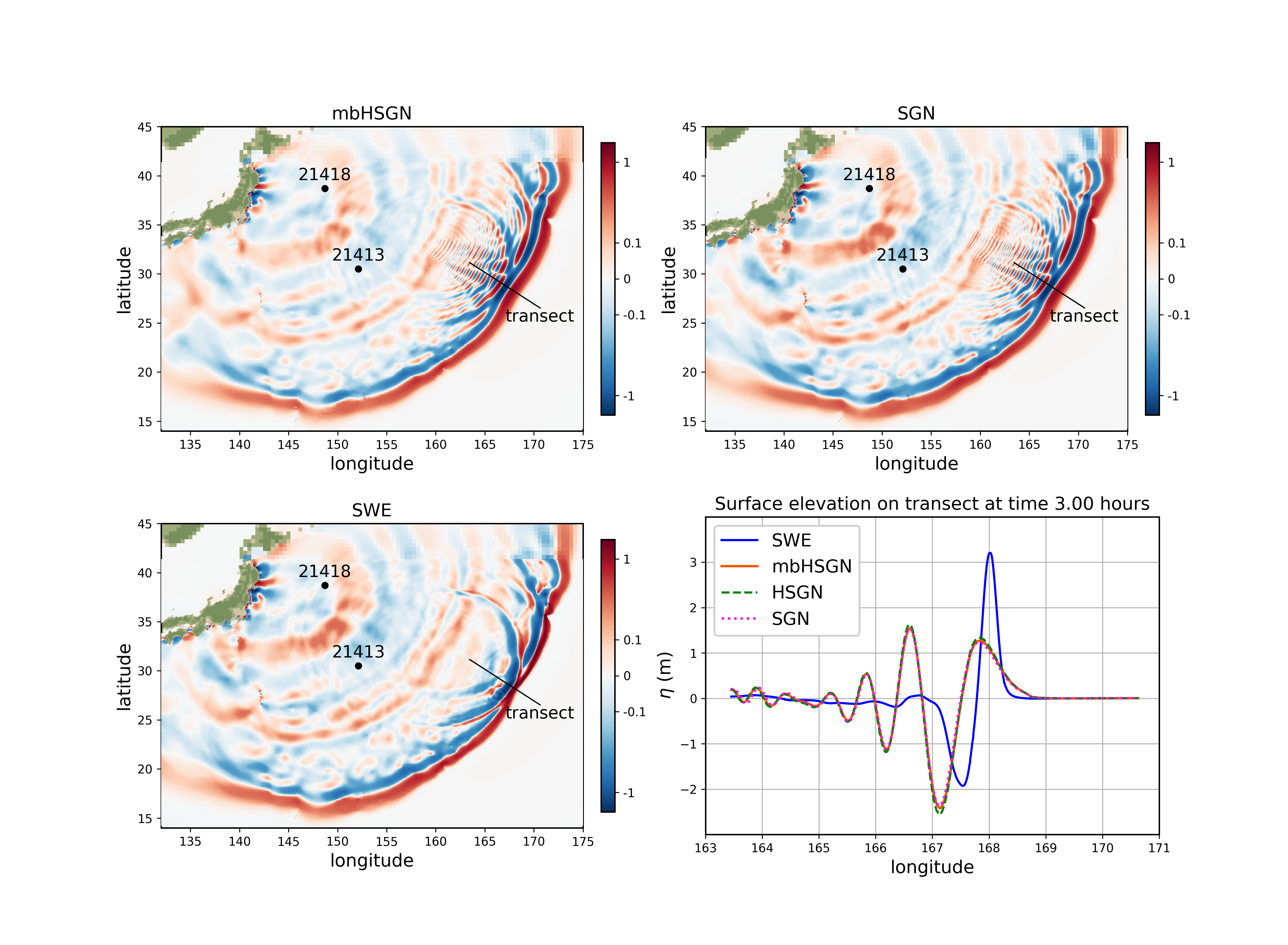
Accurate modeling of tsunamis (such as those generated by landslides) requires capturing both wave dispersion in the deep ocean and wave breaking near the shore. The shallow water equations are often preferred for working with tsunamis, but neglect dispersion and may be inaccurate in scenarios where dispersive effects are significant. In this work, we develop an approach that seeks to incorporate the best aspects of both hyperbolic and dispersive models by combining either of two hyperbolic reformulations of the Serre-Green-Naghdi equations away from the shore with the non-dispersive shallow water equations near the shore. The model is discretized and implemented within the GeoClaw software, and incorporates adaptive mesh refinement as well as shared-memory parallelism. We validate it through comparison with benchmarks and real tsunami data. The results and performance compare favorably with the existing dispersive water wave solvers, including a speedup of about 2x relative to GeoClaw's existing dispersive solver for a large-scale tsunami simulation.
Adaptive, efficient, and scalable water wave modeling with dispersive hyperbolic systems
Carlos Muñoz-Moncayo, David I. Ketcheson
arXiv preprint 2026-06-10
Accurate modeling of tsunamis (such as those generated by landslides) requires capturing both wave dispersion in the deep ocean and wave breaking near the shore. The shallow water equations are often preferred for working with tsunamis, but neglect dispersion and may be inaccurate in scenarios where dispersive effects are significant. In this work, we develop an approach that seeks to incorporate the best aspects of both hyperbolic and dispersive models by combining either of two hyperbolic reformulations of the Serre-Green-Naghdi equations away from the shore with the non-dispersive shallow water equations near the shore. The model is discretized and implemented within the GeoClaw software, and incorporates adaptive mesh refinement as well as shared-memory parallelism. We validate it through comparison with benchmarks and real tsunami data. The results and performance compare favorably with the existing dispersive water wave solvers, including a speedup of about 2x relative to GeoClaw's existing dispersive solver for a large-scale tsunami simulation.
A Hyperbolic Approximation of the Nonlinear Schrödinger Equation
Abhijit Biswas, Laila S. Busaleh, David I. Ketcheson, Carlos Muñoz-Moncayo, Manvendra Rajvanshi
Studies in Applied Mathematics 2025
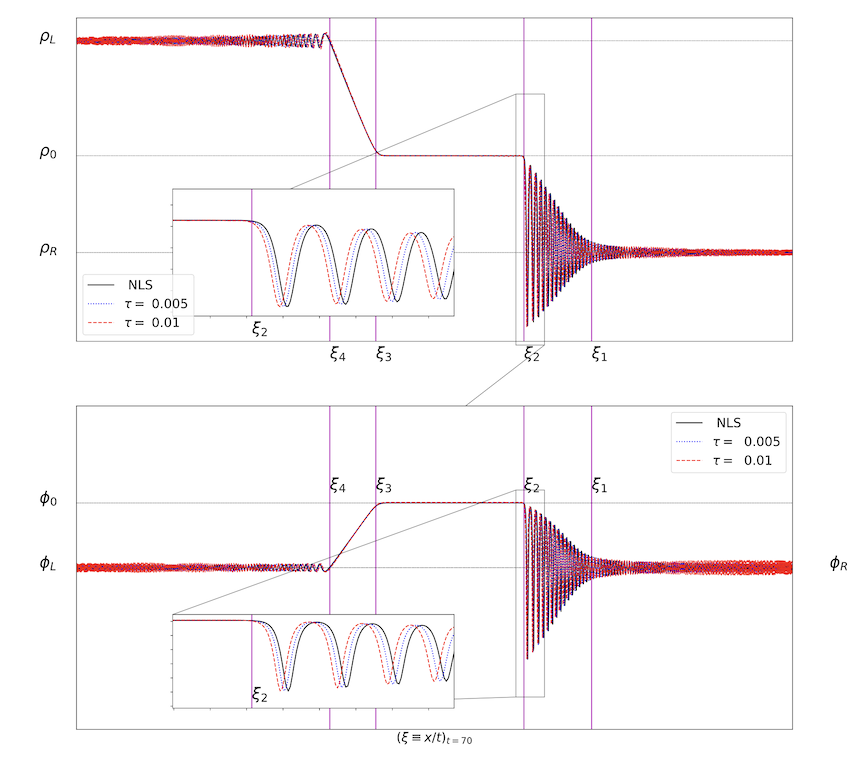
We study a first-order hyperbolic approximation of the nonlinear Schr\"odinger (NLS) equation. We show that the system is strictly hyperbolic and possesses a modified Hamiltonian structure, along with at least three conserved quantities that approximate those of NLS. We provide families of explicit standing-wave solutions to the hyperbolic system, which are shown to converge uniformly to ground-state solutions of NLS in the relaxation limit. The system is formally equivalent to NLS in the relaxation limit, and we develop asymptotic preserving discretizations that tend to a consistent discretization of NLS in that limit, while also conserving mass. Examples for both the focusing and defocusing regimes demonstrate that the numerical discretization provides an accurate approximation of the NLS solution.
A Hyperbolic Approximation of the Nonlinear Schrödinger Equation
Abhijit Biswas, Laila S. Busaleh, David I. Ketcheson, Carlos Muñoz-Moncayo, Manvendra Rajvanshi
Studies in Applied Mathematics 2025
We study a first-order hyperbolic approximation of the nonlinear Schr\"odinger (NLS) equation. We show that the system is strictly hyperbolic and possesses a modified Hamiltonian structure, along with at least three conserved quantities that approximate those of NLS. We provide families of explicit standing-wave solutions to the hyperbolic system, which are shown to converge uniformly to ground-state solutions of NLS in the relaxation limit. The system is formally equivalent to NLS in the relaxation limit, and we develop asymptotic preserving discretizations that tend to a consistent discretization of NLS in that limit, while also conserving mass. Examples for both the focusing and defocusing regimes demonstrate that the numerical discretization provides an accurate approximation of the NLS solution.
Asymptotic Behaviour of Infinitely Many Solutions for the Finite Case of a Nonlinear Schrödinger Equation with Critical Frequency
Juan Mayorga-Zambrano#, Leonardo Medina-Espinosa, Carlos Muñoz-Moncayo (# corresponding author)
Differential Equations and Dynamical Systems 2023
We consider an N-dimensional nonlinear Schrödinger equation $(P_{\varepsilon})$ with a positive Planck constant $\varepsilon>0$ and power nonlinearity $p>1$. We consider the finite case and critical frequency as described by Byeon and Wang, i.e., the continuous non-negative potential's zero level set is a singleton, around which it decays like a homogeneous positive function. In the limit $\varepsilon \to 0$, we denote the semiclassical limit problem by $(P_{\text{lim}})$. By a Ljusternik-Schnirelman scheme we get an infinite number of solutions for $(P_{\varepsilon})$ and $(P_{\text{lim}})$, $v_{k,\varepsilon}$ and $w_k$, respectively. We prove, up to a scaling, that (a) $v_{k,\varepsilon}$ subconverges to $w_k$ pointwise and in Sobolev-like norm, (b) the energy of $v_{k,\varepsilon}$ converges to that of $w_k$, and (c) $v_{k,\varepsilon}$ exponentially decays out of the zero level set of the potential.
Asymptotic Behaviour of Infinitely Many Solutions for the Finite Case of a Nonlinear Schrödinger Equation with Critical Frequency
Juan Mayorga-Zambrano#, Leonardo Medina-Espinosa, Carlos Muñoz-Moncayo (# corresponding author)
Differential Equations and Dynamical Systems 2023
We consider an N-dimensional nonlinear Schrödinger equation $(P_{\varepsilon})$ with a positive Planck constant $\varepsilon>0$ and power nonlinearity $p>1$. We consider the finite case and critical frequency as described by Byeon and Wang, i.e., the continuous non-negative potential's zero level set is a singleton, around which it decays like a homogeneous positive function. In the limit $\varepsilon \to 0$, we denote the semiclassical limit problem by $(P_{\text{lim}})$. By a Ljusternik-Schnirelman scheme we get an infinite number of solutions for $(P_{\varepsilon})$ and $(P_{\text{lim}})$, $v_{k,\varepsilon}$ and $w_k$, respectively. We prove, up to a scaling, that (a) $v_{k,\varepsilon}$ subconverges to $w_k$ pointwise and in Sobolev-like norm, (b) the energy of $v_{k,\varepsilon}$ converges to that of $w_k$, and (c) $v_{k,\varepsilon}$ exponentially decays out of the zero level set of the potential.